

By Dr. Ekta Gupta · BAMS, MD (Ayurveda) · Medical Reviewer, The Yeti Life
Key Takeaways:
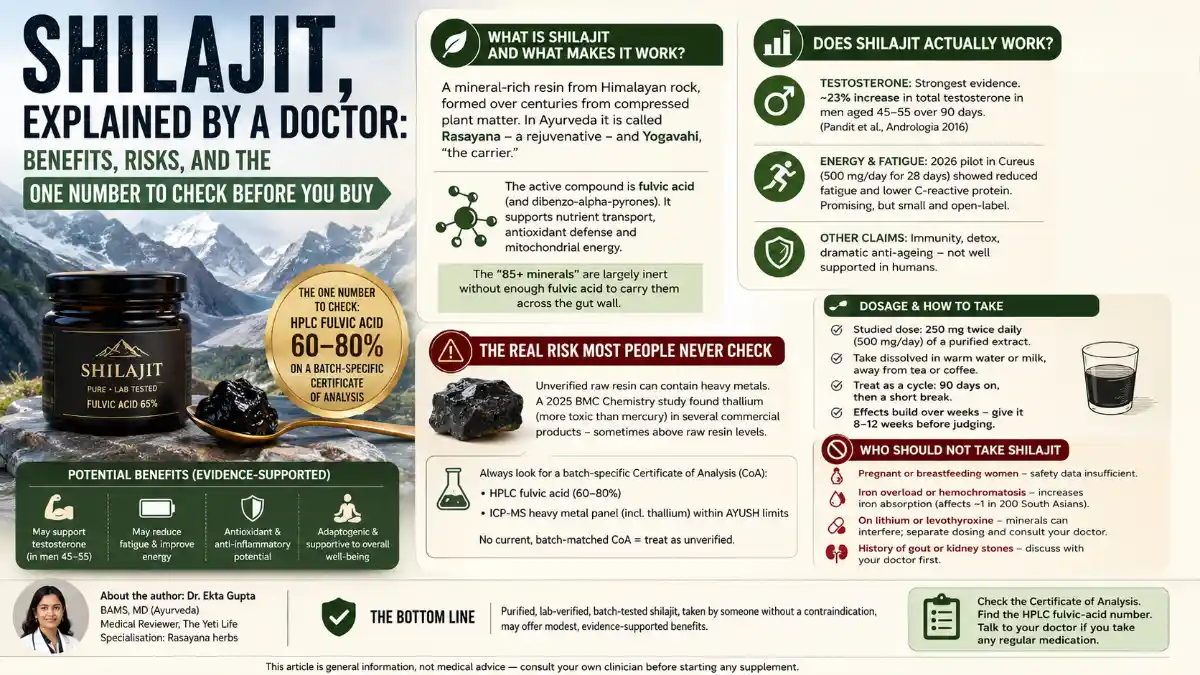
- The molecule that makes shilajit work is fulvic acid — not the “85+ minerals” on the label, which are mostly inert without it.
- Strongest human evidence: a ~23% rise in testosterone in men aged 45–55 over 90 days (Pandit et al., Andrologia 2016). Energy/fatigue data is promising but early.
- The real danger is unverified raw resin — a 2025 BMC Chemistry study found thallium (more toxic than mercury) in some commercial products.
- The one number to check: HPLC fulvic-acid content of 60–80% on a current, batch-specific certificate of analysis.
- Avoid in pregnancy/breastfeeding and iron overload; it interferes with lithium and levothyroxine — clear it with your doctor first.
If you have looked into shilajit recently, you have probably met two versions of it: the marketing version, which promises energy, testosterone, and near-miraculous vitality, and the skeptical version, which dismisses it as overpriced tar. As an Ayurvedic physician who audits supplement claims against the clinical literature, I find the truth sits in a narrower, more useful band than either camp suggests. Here is what shilajit is, what the evidence actually supports, and the single quality check that matters more than any benefit claim.
Table of Contents
What is shilajit, and what makes it work?
Shilajit is a sticky, mineral-rich resin that seeps from Himalayan rock, formed over centuries from compressed plant matter. Classical Ayurveda calls it a Rasayana — a rejuvenative — and gave it the name Yogavahi, “the carrier.”
The pharmacologically meaningful component is fulvic acid (along with dibenzo-alpha-pyrones), a small, electron-rich molecule with antioxidant activity that supports nutrient transport and mitochondrial energy production. This is the key point most marketing gets wrong: the famous “85+ minerals” are largely inert without enough fulvic acid to carry them across the gut wall. Two products with identical mineral lists can differ severalfold in real-world effect depending on fulvic-acid content — so the mineral count tells you almost nothing, and the fulvic-acid percentage tells you almost everything.
Does shilajit actually work, or is it hype?
The honest answer is: modestly, in specific areas, with real but limited evidence. The strongest single study is *Pandit et al., Andrologia 2016 — a randomized, placebo-controlled trial in healthy men aged 45–55 that recorded a roughly 23% rise in total testosterone* at 250 mg twice daily over 90 days, using purified, pharmacopoeially verified material. That is genuinely encouraging, but it is one trial, in one age group, and the effect is modest and physiological — not anabolic, and not a substitute for medical treatment of low testosterone.
For energy and fatigue, a *2026 pilot in Cureus*** (active adults, 500 mg/day for 28 days) reported reduced fatigue and lower C-reactive protein, an inflammation marker — but it was small and open-label, so read it as promising rather than proven. Beyond testosterone and early energy signals, broader claims (immunity, “detox,” dramatic anti-ageing) are not well supported in humans. For readers who want to judge the trials directly, the peer-reviewed research on shilajit catalogues the human and animal studies with evidence tiers rather than marketing summaries.
What is the real risk most people never check?
With shilajit, the danger is rarely the substance — it is unverified shilajit. Raw resin can carry whatever the surrounding rock contained, including heavy metals. A safety review (Stohs, Phytotherapy Research 2014) concluded that properly purified shilajit at sensible doses has an acceptable heavy-metal profile — but that applies to tested material, not to whatever is scraped off a mountain and sold in a tin. The concern is not hypothetical: a *2025 analysis in BMC Chemistry* detected thallium** — more toxic than mercury — in several commercial shilajit supplements, sometimes above the levels in the raw resin, and on a metal that most standard four-element panels never even tested for.
This is why the single most useful thing a buyer can do is read the lab report before the label. A credible brand publishes a per-batch certificate of analysis showing fulvic-acid content by HPLC and an ICP-MS heavy-metal screen for each production lot — the standard worth holding any shilajit to, whichever brand you ultimately choose.
What dosage is right, and how should you take it?
The dose used in the strongest trials is 250 mg twice daily (500 mg/day) of a purified, standardised extract — a reference point, not a prescription. Most people take it dissolved in warm water or milk, away from tea or coffee (tannins blunt mineral absorption). Treat it as a cycle: the positive trials ran around 90 days, and we lack data on uninterrupted multi-year use, so a 90-day run followed by a short break is the conservative default. Effects build over weeks, not days — give any honest trial 8 to 12 weeks before deciding whether it helps you.
Who should not take shilajit?
- Pregnant or breastfeeding women — safety data is insufficient.
- Anyone with hemochromatosis or iron overload — shilajit increases iron absorption (affects roughly 1 in 200 South Asians, often undiagnosed).
- People on lithium or levothyroxine — shilajit’s minerals can interfere with both; separate dosing and check with your prescriber.
- Those with gout or kidney stones — treat it as a “discuss with my doctor” item, not a self-prescribed one.
Frequently asked questions
Does shilajit really boost testosterone?
One solid human trial (Pandit et al., 2016) found a ~23% rise in men aged 45–55 over 90 days on a purified extract. It is real but modest and physiological — not anabolic, not TRT, and not studied in younger men or women. It is not a treatment for clinically low testosterone.
Will it help my energy levels?
Possibly, modestly. A 2026 Cureus pilot reported reduced fatigue and lower inflammation — promising but small and open-label. If you are persistently fatigued, get iron, B12, vitamin D, and thyroid checked first; shilajit is not a substitute for finding the cause.
How do I know a shilajit is genuine and safe?
Look for two things on a batch-specific certificate of analysis: HPLC fulvic acid of 60–80%, and an ICP-MS heavy-metal panel within AYUSH limits (ideally including thallium). No current, batch-matched certificate means treat it as unverified, whatever the packaging says.
Resin or capsule — does the form matter?
The active compound (fulvic acid) is identical across resin, powder, and capsule. Format is about dosing convenience. A tested capsule beats a “premium” resin with no certificate of analysis.
How long until it works?
Weeks, not days. The human trials ran 28–90 days. Give it a fair 8–12 week trial at the studied dose before deciding.
The bottom line
Shilajit can be a reasonable addition to a wellness routine for some people — but “shilajit is safe and effective” is only half a sentence. The full version is: purified, lab-verified, batch-tested shilajit, taken by someone without a contraindication, may offer modest, evidence-supported benefits. Every clause in that sentence is something you can verify before you spend a rupee. Check the certificate of analysis, find the HPLC fulvic-acid number, and if you take any regular medication, talk to your doctor first. With this supplement, the documentation matters more than the marketing.
About the author: Dr. Ekta Gupta holds a BAMS and an MD in Ayurveda, with clinical specialisation in Rasayana herbs. She is Medical Reviewer at The Yeti Life, where she audits clinical claims against international evidence standards. This article is general information, not medical advice — consult your own clinician before starting any supplement.
You must be logged in to post a comment.