
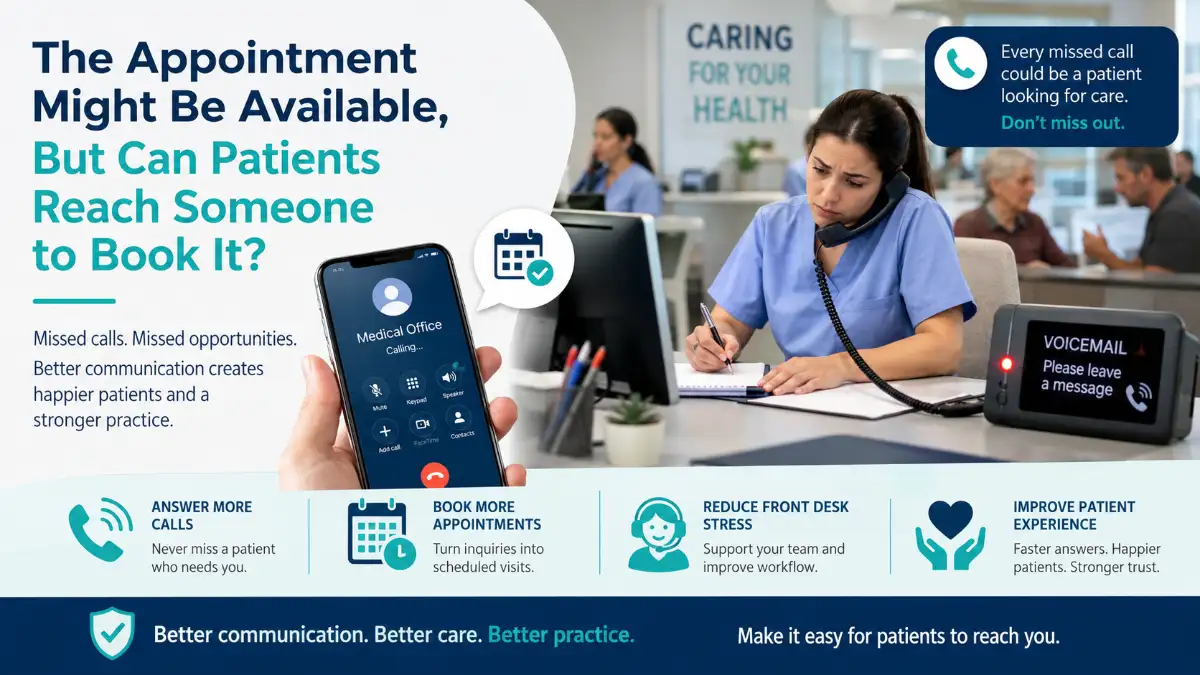

Healthcare providers spend a great deal of time focusing on patient care, clinical outcomes, compliance, staffing, and scheduling. Those priorities make sense. They are, after all, the foundation of every successful medical practice.
Yet there is another aspect of patient experience that often receives less attention.
What happens when a patient tries to call?
It sounds simple, but for many clinics and healthcare offices, phone communication has become increasingly difficult to manage.
Patients call to schedule appointments, ask questions about existing bookings, request prescription information, verify office hours, or seek guidance before visiting. Some calls are routine. Others are urgent. All of them require attention.
The challenge is that healthcare teams are already busy.
Table of Contents
A Growing Pressure on Front Desk Staff
Walk into almost any busy medical practice and you’ll likely see the same thing.
Receptionists checking patients in.
Phones ringing.
Staff answering administrative questions.
Appointments being updated.
Insurance information is being reviewed.
At the same time, patients continue arriving throughout the day.
Even highly organized offices can struggle during peak periods.
When call volume increases, staff members are often forced to choose between helping the patient standing in front of them and answering the next incoming call.
Neither option is ideal.
The result is that some calls inevitably go unanswered.
Why Patient Expectations Have Changed
A decade ago, people were generally more patient when contacting businesses and service providers.
Today, responsiveness has become part of the overall customer experience.
Patients are accustomed to receiving quick answers from airlines, banks, retailers, and countless online services. Those expectations do not disappear when they contact a healthcare provider.
When someone calls a clinic and repeatedly reaches voicemail, frustration tends to build quickly.
This is especially true when the caller is attempting to schedule care, confirm an appointment, or discuss an issue that feels important to them.
For medical practices, communication is no longer just an administrative function.
It has become part of the patient experience itself.
The Hidden Cost of Missed Calls
Most missed calls are not emergencies.
But many represent opportunities.
A new patient looking for a provider.
An existing patient trying to book a follow-up visit.
Someone seeking information before committing to treatment.
When communication becomes inconsistent, those opportunities can quietly disappear.
Patients often contact multiple providers when searching for care. If one office is difficult to reach, another clinic may end up securing the appointment instead.
Over time, that can have a measurable impact on practice growth.
Why More Practices Are Looking for Flexible Support
Hiring additional administrative staff is one solution, but it is not always practical.
Recruitment, training, scheduling, and payroll costs can make expansion difficult, particularly for smaller clinics and independent practices.
As a result, many healthcare providers have started exploring more flexible ways to improve patient communication.
One option that has gained attention in recent years is the use of a medical answering service.
Rather than replacing existing front-desk teams, these services often function as additional support during busy periods, helping practices handle incoming calls, appointment requests, and patient inquiries more efficiently.
For many clinics, the goal is straightforward.
Make it easier for patients to reach someone when they call.
A Better Experience for Patients and Staff
Communication challenges affect more than just patients.
Front-desk teams also feel the pressure.
Constant interruptions make it difficult to complete administrative work efficiently. Staff members frequently switch between in-person interactions, incoming calls, scheduling tasks, and paperwork throughout the day.
Reducing that burden can create a smoother workflow for everyone involved.
Patients receive faster responses.
Staff experience fewer interruptions.
Providers gain more time to focus on patient care.
Looking Ahead
Healthcare will always be centered on people.
Technology, scheduling systems, and operational improvements all play important roles, but patient relationships remain at the heart of every successful practice.
As patient expectations continue to evolve, communication is likely to become an even more important part of the overall healthcare experience.
For clinics looking to improve accessibility without significantly expanding internal staffing, finding better ways to manage incoming calls may be one of the simplest operational improvements available.
Sometimes the patient’s first impression of a practice begins long before they walk through the door.
Quite often, it begins with a phone call.
You must be logged in to post a comment.