
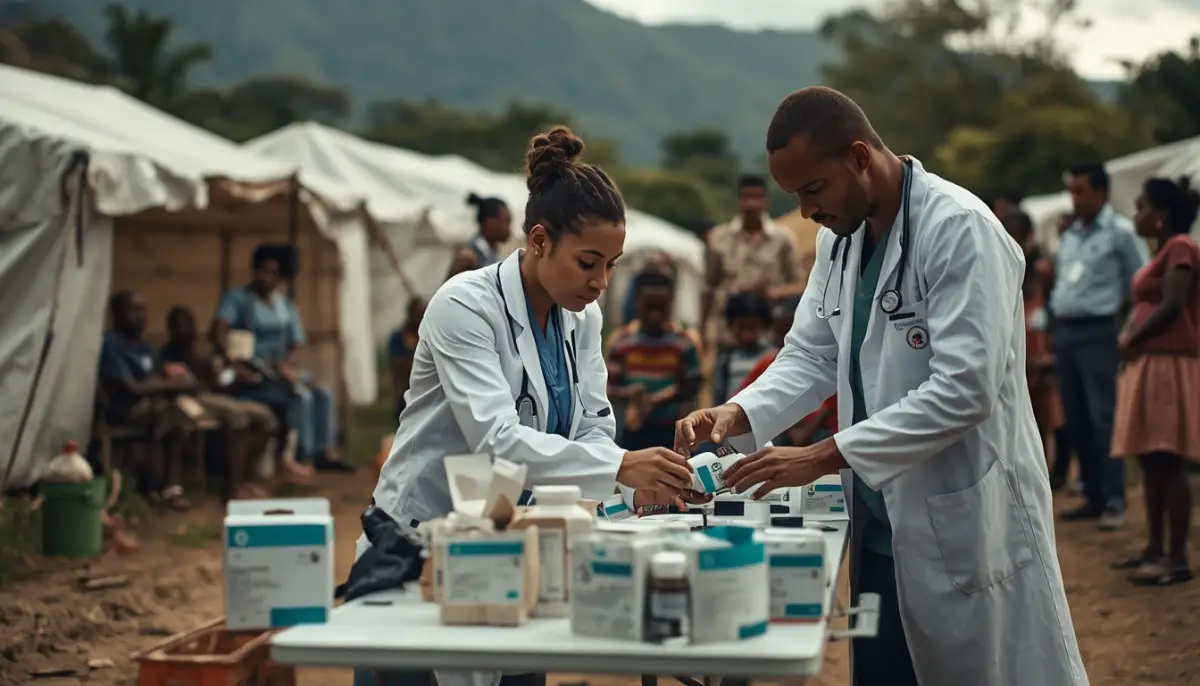

The decision to take your clinical skills into a resource-limited setting overseas is one of the most significant decisions a medical professional can make. Here is what you actually need to know before you go.
Table of Contents
The Reality Behind the Decision
Thousands of doctors, nurses, surgeons, anaesthetists, and allied health professionals abandon their homely hospital settings to work in communities where people can only get even basic forms of medical care monthly or years on. The motivations vary. There are those who are attracted by the urge to put their skills in domains that are high stakes. Others are acting on a deeper feeling that their training was not aimed at being of service to the people before them. Others just wish to know what medicine would appear like with the resources held down to the bare necessities.
However one comes to this decision made by a medical professional, the experience is not what they were anticipating, and in most cases that is what makes it such a good experience. However, being unprepared changes everything, not only the results you will be able to achieve but also your personal welfare at the time and later in the placement.
This is the practical ground guide; how to align your competencies to the appropriate programme, what visa and credentialing information usually begins to resemble, how to take care of your own well-being in the field, and where to locate a respectable body that will put your knowledge to truly useful application.
Matching Your Skills to the Right Programme
One of the most common mistakes first-time medical volunteers make is choosing a programme based on geography or timing rather than clinical fit. The emotional pull of a particular country or crisis is understandable, but a surgeon sent to a setting that primarily needs primary care physicians, or a GP deployed to assist with complex cardiac cases outside their scope, helps nobody and risks patient harm.
Reputable international medical volunteer organisations do rigorous skills matching before deployment. They will ask for your specialty, your years of post-qualification experience, your procedural competencies, and in many cases, specific references from supervisors who can speak to your clinical performance under pressure. If an organisation will take anyone with a medical degree and a pulse, that is worth questioning.
The most effective volunteer deployments tend to fall into one of three categories. Surgical missions focus on high-volume, high-impact procedures that communities cannot access locally, such as cataract surgery, cleft palate repair, and orthopaedic corrections. Primary and community health missions address the broad burden of preventable and treatable illness at a population level. Specialist training missions pair visiting consultants with local medical staff specifically to build in-country capacity that remains after the team leaves.
Understanding what medical volunteering overseas is really like on the ground before you commit to a placement is genuinely useful. First-hand accounts from medical professionals who have been through the experience cover the practical texture of working in under-resourced environments in ways that programme brochures rarely do.
Visa Requirements and Medical Credentialing Abroad
The administrative side of international medical volunteering is one of the areas that catches professionals off guard most often. Many assume that their home country medical registration, combined with a volunteer visa, is sufficient to practice legally in their destination country. In most cases, it is not that simple.
Visa categories for medical volunteers vary significantly by country. Some nations offer specific humanitarian or volunteer visas that permit unpaid clinical work. Others require a short-term work permit even for volunteer activity. A smaller number require the visiting professional to hold temporary registration with the national medical board before they can legally see patients.
The credentialing requirements are equally variable. Some destination countries require authenticated copies of your medical degree, specialist certificates, and current registration certificates from your home board. Others ask for a letter of good standing, a criminal background check, and a formal letter of invitation from the in-country host organisation. Processing timelines for these documents can run from two weeks to three months, which is why starting the administrative preparation at least four to six months before your intended departure date is strongly recommended.
Your deploying organisation will typically guide you through the credentialing requirements for your specific destination, but do not assume they will manage the process entirely on your behalf. Responsibility for holding valid authorisation to practice rests with the individual clinician.
Health, Safety, and Personal Preparation
Occupational health aspect of international medical volunteering is neglected in the pre-departure planning. Professionals with a history of working within well-equipped hospitals and with solid infection control measures find the transition to field work to be literally mind-boggling, and the potential health consequences to their individual health are tangible.
The prophylaxis and pre-travel vaccinations depending on the destination differ. The coverage as required or recommended is generally high in the case of Sub Saharan African and South-Southeast Asian assignments, Hepatitis A and B, typhoid, meningococcal, rabies and yellow fever. Prophylaxis against malaria is necessary in the endemic areas and the decision on whether to take atovaquone-proguanil, doxycycline or mefloquine is needed to be made in collaboration with a physician in travel medicine at least 6 weeks prior to the travel date.
Sharps injury risk deserves particular attention. In settings with limited access to HIV antiretroviral post-exposure prophylaxis, the standard clinical protocols around sharps handling become even more critical. Confirm with your deploying organisation whether PEP medication is available on-site and what the emergency evacuation procedures are for serious clinical incidents.
Psychological preparation matters just as much as physical preparation. Working with high patient loads, limited diagnostic equipment, and the knowledge that patients who cannot be treated will not find care elsewhere creates a specific kind of occupational stress that is quite different from burnout in a domestic hospital setting. Professionals who have worked through what it means for your career and sense of purpose when medical volunteering operates at that level of intensity consistently report that debriefing and peer support structures during and after the placement are not optional extras. They are essential.
Finding a Reputable Organisation
The worldwide network of medical volunteering is between hard-core professional, well-financed organisations with decades of experience in the field up to short-term initiative type that is of little value to the host community and takes out more than it gives in. It is good to know how to make a distinction.
Signifiers of an ethical, credible organisation also encompass existence of formal skills matching and vetting process, in country support system in place of deployed volunteers, defined relationship with local health authorities, partner hospitals, publicity of clinical outcomes and its willingness to develop local health system capacity not to run parallel to it permanently.
Mercy Ships is one of the best-known brands in the industry to doctors contemplating an organized, long-term outreach to a severely inaccessible community when it comes to surgical services. The Australian branch of the organisation that is based in Australia is running a special programme where medical professionals considering volunteer as a doctor abroad country can join the organisation via their hospital ship programme, offering free surgery services to patients who would have no access to it. The programme has been very keen on volunteer preparation, on board clinical support and debriefing after the deployment hence making it a good choice by professionals undertaking this type of work at the first instance.
Other reputable organisations are Medecins Sans Frontieres to professionals who want to work towards active humanitarian disasters, International medical Corps in cases of disaster response and extended development programmes, and Health Volunteers Overseas where professionals undertake speciality-specific place capacity-building opportunities in collaboration with regional institutions.
Before You Commit: Questions Worth Asking
Before signing on with any programme, it is worth getting clear answers to a few specific questions. What is the minimum commitment duration, and what clinical activities will you actually be performing? Who provides malpractice and medical indemnity coverage for volunteers, and does it extend to your destination country’s jurisdiction? What accommodation, food, and in-country transport are provided? What is the protocol if a volunteer becomes seriously ill or injured during deployment?
If an organisation is evasive or vague on any of these points, keep asking. A well-run programme will have clear, documented answers because they have dealt with every one of these situations before.
Going overseas to practise medicine in a resource-limited setting is one of the more demanding things a clinician can choose to do with their skills and their time. Done well, with the right preparation and the right organisation, it is also one of the most professionally and personally significant.
Are you a medical professional who has completed an international volunteer placement? Share your experience and advice for first-timers in the comments below.
You must be logged in to post a comment.