
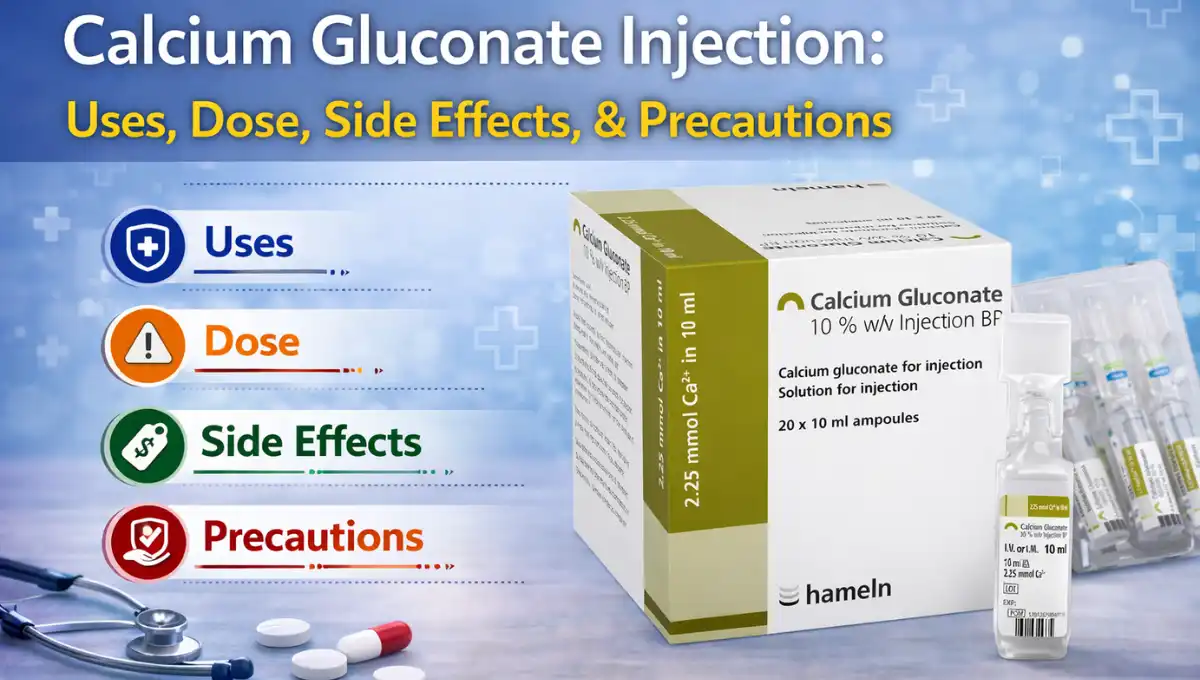

Calcium gluconate injection is your new hospital hero to immediately correct life-threatening low calcium levels, stop harmful muscle spasms, heart problems, and more. Having trouble finding the best information on uses, dose, costs, and life-saving tips for this injection? Well, you’ve come to the right place. We’ve curated the best facts for you to date.
| Name | Calcium Gluconate Injection |
| Price | Rs. 7.13 for a vial of 10 ml |
| Manufacturer | Vulcan Laboratories Pvt Ltd |
| Uses | Treatment of Calcium Deficiency |
| Composition | Calcium Gluconate (10% w/v) |
Table of Contents
What is Calcium Gluconate Injection?
Calcium gluconate injection is a liquid that must be administered within a vein to increase the amount of calcium in a person in emergency cases. It is used to treat the signs and symptoms of hypocalcemia which may be caused by dysfunction of the parathyroid and vitamin D deficiency resulting in seizures, tetany and heart arrhythmias. Health professionals choose it due to safety in veins over harsher agents, which is essential in emergency care.
Calcium Gluconate Injection Composition
It is not pure elemental calcium. Instead, the active component is bound by calcium gluconate, a compound well known as a safe and effective means of delivering calcium by IV. It comes in the most commonly concentrated form of 10% calcium gluconate.
- Each 1 ml liquid contains 100mg calcium gluconate.
- Each 1 gram of calcium gluconate has approximately 89mg of real calcium which is a mineral your body requires to work.
The solution has to be absolutely clear. If there is any cloudiness or particles present, the solution should not be used, as the calcium might have precipitated out of the solution, which can be dangerous.
Calcium Gluconate Injection Tablets Uses
The calcium gluconate injection has a number of uses, all of which are urgent medical situations.
- Severe Hypocalcemia: The Primary Use. This application treats low calcium levels that can cause muscle spasms (tetany), seizures, numbness, and irregular heart rhythms.
- Magnesium Sulfate Overdose: It can be directly given as an antidote to neutralize the overdose effects of magnesium, which can cause respiratory depression.
- Hyperkalemia Emergency: It acts to stabilize a life-threatening high level of potassium in the blood, to prevent the stopping of the heartbeat.
- Adjunct for Toxins: It can help relieve painful muscle spasm caused by certain insect bites or stings, such as those of black widow spiders.
- Other Hospital Uses: It is also used in cases when there has been a need for massive blood transfusions to overcome problems caused by citrate or in critical care situations under the supervision of doctors.
Calcium Gluconate Injection Dosage
There is no set dosage of calcium gluconate injection, nor can it be determined by any method. The exact dosage of the drug calcium gluconate injection depends on different factors, including the condition being treated, the age of the individual, and the body weight of the individual. This drug is always given slowly into a vein to avoid any serious side effects.
- For Severe Hypocalcemia in Adults: An initial dose of 10 ml of the 10% solution is usually administered slowly by intravenous injection, at least 5-10 minutes apart. A maintenance dose of 40 ml diluted with IV fluids may be run over 24 hours.
- To children: The amount of the dose is dependent on weight. The initial slow injection is the normal dose, which is 0.5ml/kg (and a total of 10ml or less).
- In case of Emergencies such as Hyperkalemia: The dose is also weight-based and it is normally within the range of 60 and 100 mg/kg.
- Important Safety Measure: It should never be administered intramuscularly (IM) or subcutaneously (SC) since it produces serious tissue necrosis in the sites of injection.
Calcium Gluconate Injection Storage
As a medication that requires hospital administration, it is not hosted at home. In clinical settings:
- The unopened ampoules or vials should be stored at temperatures between 25 °C to 30 °C in a cool and dry environment, neither under light nor under freezing conditions.
- Medical practitioners test the solution, and the solution must be transparent. If it is cloudy or has particles in it, it is discarded.
- Once a single-use vial has been opened, it must be used immediately. Solutions to be diluted for infusion shall also be infused immediately.
Calcium Gluconate Injection Benefits
The primary benefit of such an injection is the speed and dependability that it provides in emergency scenarios. It provides life-saving intervention with:
- Prevention of Acute Symptoms: Rapidly eliminates life-threatening muscle spasms, seizures or heart racing due to calcium deficiency.
- Protecting the Heart: Stabilization. The electrical activity in the heart is stabilized with high potassium to avoid cardiac arrest.
- Antidotal effect Toxins: It has an antidotal effect on magnesium overdose.
- Accessible Immediacy: It is administered when administration of calcium by oral methods is not feasible such as in surgical surgery, unconscious patients, or when the person is severely vomiting.
Calcium Gluconate Injection Side Effects
The injection is very effective but, nevertheless, could cause side effects if given too fast.
Common, Mild Effects (often temporary):
- A sensation of warmth particularly on the chest and face of the body.
- Tingling, alcoholism, or slight nausea during injection.
Immediate Medical Intervention: Serious Side Effects:
- The indicators of High Calcium (Hypercalcemia): excessive thirst, urination, confusion, vomiting, exhaustion.
- Cardiovascular: Slowness of heart rate, tachycardia, and arrhythmia; dizziness; hypertension.
- Allergic Reaction: Rash, itch, hives, face or throat swelling.
- Injection Site Problems: Severe pains, redness or burning, tissue damage in case the injection seeps out and enters the skin (extravasation).
Calcium Gluconate Injection Precautions
Safe use mandates appropriate medical management and the importance of providing medical care professionals with your entire medical history.
- Contraindications: It must not be used in patients who have elevated calcium levels in the blood, severe illnesses associated with the kidneys or those under digoxin therapy (digitalis) unless with extreme caution because of the chances of fatal heart rhythms developing.
- Drug Interactions: Always talk to your physician about all the medications. The main ones are:
- Ceftriaxone (antibiotic): Mortality risk of severe lung/renal involvement in case of both combinations; the IV lines should be flushed thoroughly.
- Digoxin: Increased risk of toxicity.
- Some diuretics (water pills) can have an impact on the level of calcium.
- Special Conditions:
- Use in pregnancy or breastfeeding only when absolutely necessary under medical advice.
- Requires an Electrocardiogram and Calcium Level monitoring during infusion.
- During and after injection, generally, patients are in a lying-down position to avoid dizziness.
Frequently Asked Questions
Ans. Its main uses are to treat severe, symptomatic hypocalcemia (dangerously low calcium) and to act as an antidote for magnesium sulfate overdose. It’s also used in hyperkalemia (high potassium) emergencies to protect the heart.
Ans. The dose is strictly calculated by a doctor based on weight and condition. For severe hypocalcemia, a common adult dose is 10 ml (1g). Pediatric doses are weight-based (e.g., 0.5 ml/kg).
Ans. In India, this injection is available at around Rs. 7.13 for a vial of 10 ml, but prices vary widely by brand, pharmacy, and country.
Ans. It quickly stabilizes heart membranes during life-threatening high potassium, stops severe muscle spasms or seizures from low calcium, and immediately reverses magnesium toxicity, all scenarios where every minute counts.
Ans. This refers to the standard 10% solution strength. A “10 calcium gluconate injection” means a 10 ml ampoule contains a 10% concentration, equaling 1 gram of calcium gluconate.
You must be logged in to post a comment.