
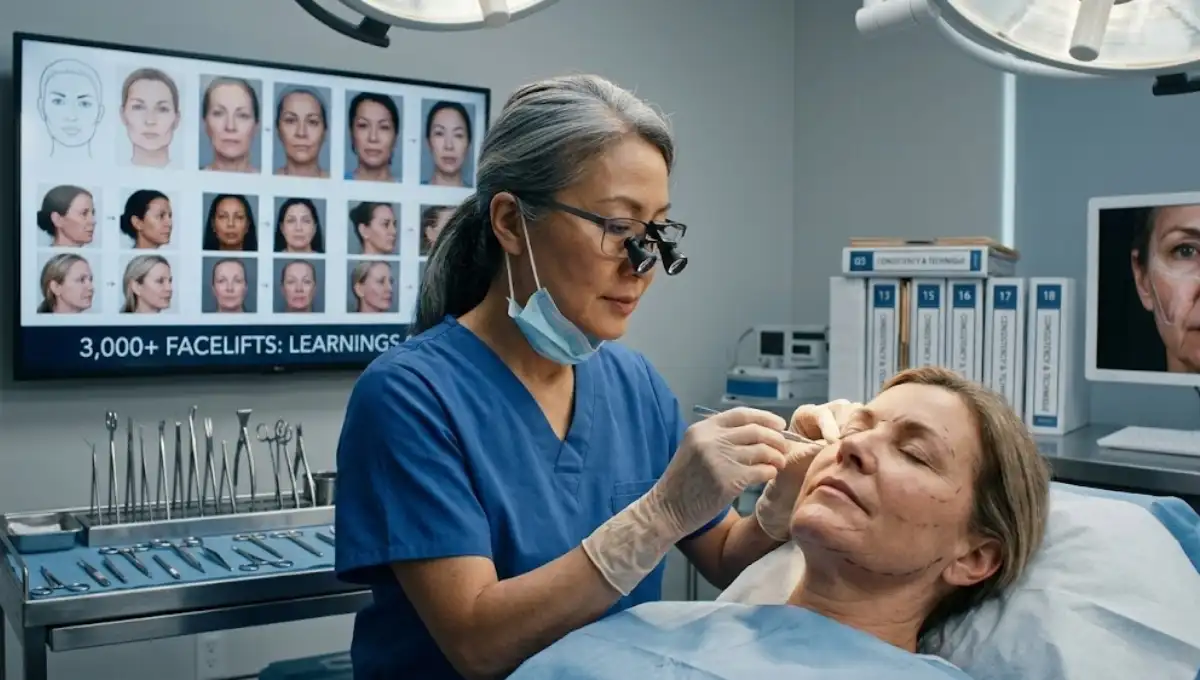

When it comes to facelift surgery, results are not just about skill—they are about consistency built over time. Surgeons who have performed thousands of procedures develop deeper pattern recognition, refined techniques, and predictable outcomes. This article explores what more than 3,000 facelifts reveal about repetition, precision, and long-term results. You will learn why consistency matters more than creativity and how experience directly impacts safety, natural appearance, and lasting success.
Table of Contents
The Real Advantage of Repetition
Doing one facelift well is skill.
Doing 3,000 facelifts well is pattern recognition.
That is where consistency comes from.
Each procedure adds data. Not abstract data. Real outcomes. Real healing. Real long-term results.
Surgeons start to see what holds and what fails. They see which techniques age well and which ones fade.
“I remember a patient from early in my career,” one surgeon shared. “She looked great at six months. At two years, the lift had softened more than expected. That case stayed with me. It pushed me to rethink how I handled deeper structures.”
That is how repetition works. It removes guesswork.
Why Consistency Matters More Than Creativity
Aesthetic surgery is not about trying something new every time.
It is about doing the right thing the same way, every time.
Consistency reduces variation. Less variation means fewer surprises.
According to surgical outcome studies, complication rates decrease significantly when surgeons specialise and repeat the same procedures at high volume.
That applies directly to facelifts.
More than 78,000 facelifts are performed each year in the United States. Results vary widely. Technique and experience drive that variation.
The Myth of “Artistry Alone”
People often describe facial surgery as art.
That is partly true. But technique drives outcomes.
Without consistent technique, artistry does not scale.
“Art without structure creates inconsistency,” one surgeon noted. “Structure allows results to repeat.”
What 3,000+ Cases Reveal About Technique
Patterns start to appear after hundreds of cases. At thousands, they become clear.
Skin Is Not the Problem
Early techniques focused on skin tightening.
With repetition, surgeons learn that skin is not the core issue. It stretches. It relaxes.
The deeper layers matter more.
This insight pushes surgeons toward structural techniques like deep-plane facelifts.
Tension Placement Changes Everything
Where tension sits determines how a result ages.
If tension is on skin, results fade faster.
If tension is distributed through deeper layers, results last longer.
“I used to close incisions with more tension than I do now,” one surgeon admitted. “Over time, I realised the best closures felt almost relaxed. That only happens when the deeper work is correct.”
Small Adjustments Create Big Gains
After enough cases, small changes become important.
A few millimetres of release. A slight change in vector. A different approach to ligament handling.
These are not visible to patients. They are critical to outcomes.
The Role of Feedback Loops
Consistency improves through feedback.
Not just immediate results. Long-term follow-up.
Surgeons review patients years later. They compare outcomes across time.
This creates a feedback loop:
- Perform surgery
- Observe healing
- Track long-term changes
- Adjust technique
Dr. Ariel Rad reviews often emphasise this process. With more than 3,000 facelifts performed, long-term tracking becomes a built-in system.
He once described reviewing a patient five years after surgery: “She didn’t look tight. She looked like herself, just rested. That’s when I knew the technique was working.”
That type of feedback cannot be rushed.
What Consistency Looks Like in Practice
Consistency is not just surgical skill. It is system design.
Pre-Operative Planning
Every case starts with structured evaluation.
- Facial anatomy assessment
- Skin quality review
- Fat distribution analysis
- Patient goals aligned with anatomy
No shortcuts.
Standardised Technique
The core steps remain stable.
Variation is minimal. Adjustments are intentional.
This reduces error.
Controlled Environment
Procedures are done in hospital-based or accredited settings.
Safety protocols are fixed. Team roles are clear.
Consistency extends beyond the surgeon.
Actionable Lessons for Patients
Patients can use these insights when choosing a surgeon.
Ask About Volume
- How many facelifts have you performed?
Numbers matter. Repetition builds experience.
Ask About Technique Stability
- Has your technique changed over time? Why?
Good surgeons refine. They do not reinvent constantly.
Ask About Long-Term Results
- Can you show results at 3–5 years?
Short-term photos are not enough.
Ask About Revision Rates
- How often do your patients need secondary procedures?
Low revision rates signal consistency.
Why High Volume Improves Outcomes
High-volume surgeons develop efficiency.
Not speed for its own sake. Efficiency in decision-making.
They recognise patterns faster. They avoid common pitfalls.
Studies across surgical fields show that higher procedural volume correlates with:
- Lower complication rates
- Shorter recovery variability
- Better long-term outcomes
Facelifts follow the same pattern.
The Balance Between Consistency and Adaptation
Consistency does not mean rigidity.
Good surgeons adapt. But they adapt within a stable framework.
They test changes carefully. They track results before adopting new methods widely.
“I don’t change technique because something is popular,” one surgeon explained. “I change it when my own data shows improvement.”
That approach protects patients.
Common Mistakes That Consistency Solves
Over-Tightening
Early-career surgeons may rely on skin tension.
With experience, they shift tension deeper.
Over-Correction
Trying to create dramatic change often leads to unnatural results.
Consistency leads to restraint.
Inconsistent Planning
Without a system, planning varies case by case.
Consistency standardises evaluation.
The Long-Term Payoff
Consistency shows up years later.
Patients return looking natural. Results hold.
Surgeons build confidence in their method.
One surgeon described a long-term patient this way: “She came back after seven years. No one knew she had surgery. That’s the goal.”
That outcome is not accidental.
It is built through repetition.
Final Takeaway
3,000 facelifts teach one core lesson: consistency beats variation.
Technique matters. Repetition refines it. Feedback improves it.
Patients should look beyond before-and-after photos. They should ask about process, volume, and long-term results.
In aesthetic surgery, the best work is often the least visible.
It looks natural. It lasts. It repeats.
That is what consistency delivers.
You must be logged in to post a comment.