
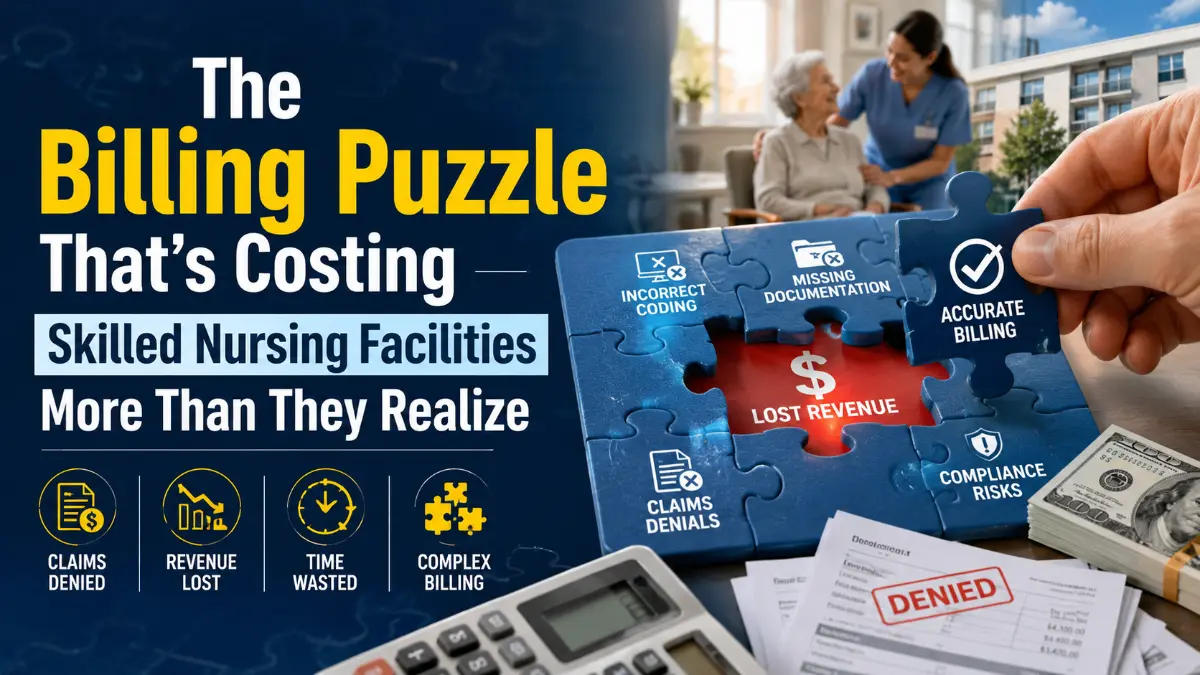

There is a particular kind of financial pain that skilled nursing facility administrators know well. It doesn’t arrive as a single catastrophic event. It accumulates quietly, claim by claim, month by month, in the space between what was billed and what was actually owed – and in the gap between what a facility assumed was covered and what the rules actually say.
Billing complexity in the post-acute care world is not a new problem. But as reimbursement models have grown more sophisticated, as Medicare’s payment structures have evolved, and as the volume of specialized services delivered inside skilled nursing facilities has expanded, the margin for misunderstanding has narrowed considerably. What a facility doesn’t know about how its billing is structured isn’t just an administrative inconvenience. It’s a direct threat to financial stability.
One of the most consequential – and most frequently misunderstood – areas in this landscape involves the rules governing which services are bundled into a facility’s standard Medicare payment and which are not. Getting this wrong doesn’t just mean leaving money on the table. In some cases, it means billing incorrectly in ways that create compliance exposure long after the original claim has been processed.
The facilities that navigate this terrain most successfully are not necessarily the largest or the most sophisticated. They are the ones that have taken the time to understand precisely where the boundaries lie – and built their billing workflows around that understanding.
Table of Contents
How the Bundling Logic Works – and Where It Breaks Down
Medicare’s approach to paying for skilled nursing facility care is built on a bundling philosophy. When a patient is admitted to a skilled nursing facility under a Part A stay, the expectation is that the facility’s per diem rate covers the comprehensive cost of that patient’s care – room, board, nursing, therapy, and a broad range of ancillary services. The facility receives a single consolidated payment and is responsible for coordinating everything within it.
This model has a certain administrative elegance. It simplifies the payment relationship between Medicare and the facility, shifts care coordination responsibility to a single accountable entity, and theoretically creates incentives for facilities to manage costs efficiently across the full scope of a patient’s needs.
But the elegance of the model conceals a significant layer of complexity. The bundling is not total. There are specific services, specific circumstances, and specific provider types that fall outside the consolidated payment – situations where Medicare does not expect the facility’s rate to cover the cost, and where separate billing to Part B is not only permitted but required.
Understanding exactly which services fall inside the bundle and which fall outside it is one of the most operationally significant challenges in skilled nursing facility billing. And the consequences of getting it wrong run in both directions: billing separately for something that should be bundled generates overpayment liability, while failing to bill separately for something that is legitimately excluded means absorbing costs that Medicare would have covered.
This is the terrain that a careful review of consolidated billing exclusions illuminates – a set of rules that define the precise boundaries of the bundle, and that carry real financial consequences for facilities that don’t understand where those boundaries fall.
The Services That Don’t Fit the Bundle
The categories of services that fall outside the consolidated payment structure are not arbitrary. They tend to share a common characteristic: they involve highly specialized care that most skilled nursing facilities are not equipped to deliver internally, or services where the clinical relationship with an outside provider is too direct and too specific to be absorbed into a facility’s general rate.
Certain physician services fall into this category. When a physician provides a service directly to a patient – not as part of the facility’s general care coordination, but as a distinct clinical intervention – that service is typically billed separately under Part B. The facility’s consolidated rate was never designed to absorb the cost of specialist physician work.
Similarly, certain categories of high-cost therapies and diagnostic services may qualify for separate billing depending on the clinical circumstances and the patient’s coverage status. The rules here are not always intuitive. A service that is bundled under one set of circumstances may be billable separately under another, depending on factors including the patient’s diagnosis, the timing of the service relative to the admission, and the specific Medicare benefit period involved.
Certain durable medical equipment items also sit outside the consolidated payment in specific circumstances. Prosthetic devices, orthotics, and related supplies can sometimes be billed separately to Part B – but only when the applicable conditions are met and the documentation supports the claim.
| Service Category | General Rule | Key Variable |
| Physician services | Generally excluded from bundle | Direct patient care vs. administrative |
| High-cost therapies | Varies by circumstance | Diagnosis, timing, benefit period |
| Durable medical equipment | May be excluded | Device type, clinical justification |
| Diagnostic tests | Some excluded, some bundled | Test type, ordering provider |
| Ambulance services | Generally excluded | Transport purpose and destination |
The Documentation Problem
Knowing which services are excluded from consolidated billing is only half the challenge. The other half is building the documentation infrastructure to support separate billing when it is appropriate – and to defend those claims if they are ever questioned.
Medicare’s audit apparatus has grown considerably more sophisticated over the past decade. Recovery Audit Contractors, Unified Program Integrity Contractors, and Targeted Probe and Educate reviews are all capable of identifying billing patterns that appear inconsistent with the consolidated payment rules. When an audit targets a skilled nursing facility, the question being asked is almost always some version of: was this separate bill legitimate, or should this service have been included in the facility’s per diem?
The answer to that question is found in the documentation. If the clinical record supports the medical necessity of the service, establishes the appropriate provider relationship, and demonstrates that the conditions for an exclusion were met, the claim is defensible. If the documentation is thin, inconsistent, or missing, even a legitimate billing decision becomes difficult to sustain under scrutiny.
This creates a practical imperative for facilities: the billing decision and the documentation decision cannot be separated. They need to happen together, as part of a unified workflow that captures both the clinical rationale and the billing justification at the point of service. Facilities that try to reconstruct documentation after the fact – when an audit demand letter arrives – are working from a fundamentally weaker position than those that built the record correctly from the beginning.
Why This Is Getting Harder, Not Easier
The complexity of skilled nursing facility billing has not been static. Several converging trends have made this terrain more difficult to navigate over the past several years, and there is little reason to expect that trajectory to reverse.
The shift toward value-based payment models has introduced new layers of coordination between skilled nursing facilities and the hospital systems, accountable care organizations, and managed care plans they work with. Each of those relationships comes with its own contractual requirements, its own billing expectations, and its own audit risk profile. What is appropriate billing under traditional Medicare fee-for-service may not be the right approach under a managed care contract – and the rules governing exclusions may differ across payment arrangements in ways that are not always clearly communicated.
At the same time, the acuity of patients being admitted to skilled nursing facilities has increased. Patients who a decade ago might have remained in an acute care setting are now being discharged to post-acute care earlier in their recovery. They arrive with more complex medical needs, more active specialist relationships, and a higher likelihood of requiring services that fall at the boundaries of the consolidated payment structure.
“The patients coming through our doors today look different than they did five years ago. More complex. More specialists involved. The billing has to keep up with the clinical reality, and that’s not always straightforward.” – Director of Reimbursement, regional skilled nursing facility network
Finally, the regulatory environment itself continues to evolve. CMS updates its billing guidance, issues new transmittals, and adjusts the boundaries of bundled payments through the rulemaking process. Facilities that are not actively monitoring these changes risk operating on outdated assumptions – and making billing decisions based on rules that no longer reflect current policy.
The Compliance Dimension
It would be a mistake to think about this purely as a revenue optimization issue. The compliance dimension is equally significant and, for some facilities, more immediately consequential.
Incorrect billing in the skilled nursing facility context – whether through overbilling for excluded services or through systematic patterns of unbundling services that should be included in the per diem – can trigger False Claims Act liability. The financial exposure under that framework is not limited to the amount of the original overpayment. It includes treble damages and per-claim penalties that can rapidly escalate into amounts that threaten a facility’s operational viability.
The government’s enforcement focus in post-acute care has been consistent and sustained. Skilled nursing facilities have been the subject of significant False Claims Act settlements and criminal prosecutions related to billing irregularities. The fact that a billing error was unintentional provides limited protection when the pattern of errors is systematic and the amounts involved are substantial.
This is why facilities that approach consolidated billing as a compliance matter – not just a revenue matter – are better positioned to manage their risk. When billing decisions are made within a framework of documented policy, regular training, and internal audit, the organization can demonstrate that it was acting in good faith and with reasonable diligence. That posture matters enormously when regulators come asking questions.
Building a Billing Framework That Holds Up
The facilities that have the best track record in this area share a common approach. They treat billing policy as a clinical and administrative joint responsibility – not something delegated entirely to the billing department. They invest in regular training so that the clinical staff who generate the documentation understand how that documentation connects to billing decisions. And they build internal review processes that catch anomalies before they become patterns.
Periodic internal audits of claims involving potential exclusions are particularly valuable. A structured review that asks “should this have been billed separately?” – and “do we have the documentation to support it if it was?” – applied consistently across a sample of claims will surface problems that might otherwise go undetected until an external audit finds them first.
The specific rules governing which services qualify for separate billing, under what conditions, and through what documentation requirements are detailed and nuanced. Staying current with those rules – and translating them into practical billing protocols – is an ongoing operational commitment, not a one-time setup task. A thorough understanding ofconsolidated billing exclusions is not optional background knowledge for skilled nursing facility billing teams. It is the foundation on which compliant and financially sound billing decisions are built.
The Strategic Value of Getting This Right
Beyond compliance and revenue recovery, there is a strategic dimension to mastering the billing boundaries in skilled nursing care. Facilities that have clear, defensible billing practices are better partners for the health systems and managed care organizations they work with. They generate fewer claim disputes, fewer audit findings, and fewer delays in payment – all of which contribute to stronger referral relationships and a more predictable revenue cycle.
In a competitive post-acute care market, operational credibility matters. A facility that can demonstrate clean billing practices, low audit risk, and a systematic approach to compliance is a more attractive partner for hospitals managing their own discharge planning and post-acute network strategy. The investment in getting billing right is not just a defensive measure – it is a differentiator.
There is also the question of staff confidence. Billing teams that understand the rules, have clear protocols to follow, and receive regular updates when the regulatory environment changes are more effective and less prone to the kind of drift that creates compliance risk over time. Building that institutional knowledge is a leadership responsibility, and the facilities that take it seriously are consistently better positioned – financially, operationally, and reputationally – than those that treat billing as a back-office function rather than a strategic priority.
The puzzle of post-acute billing is not going to simplify itself. The rules will continue to evolve, the patient population will continue to grow more complex, and the scrutiny from payers and regulators will continue to intensify. The facilities that thrive in that environment will be the ones that stopped guessing and started knowing – precisely where the lines are, precisely what documentation is required, and precisely how to build a billing operation that can defend every claim it submits.
You must be logged in to post a comment.