
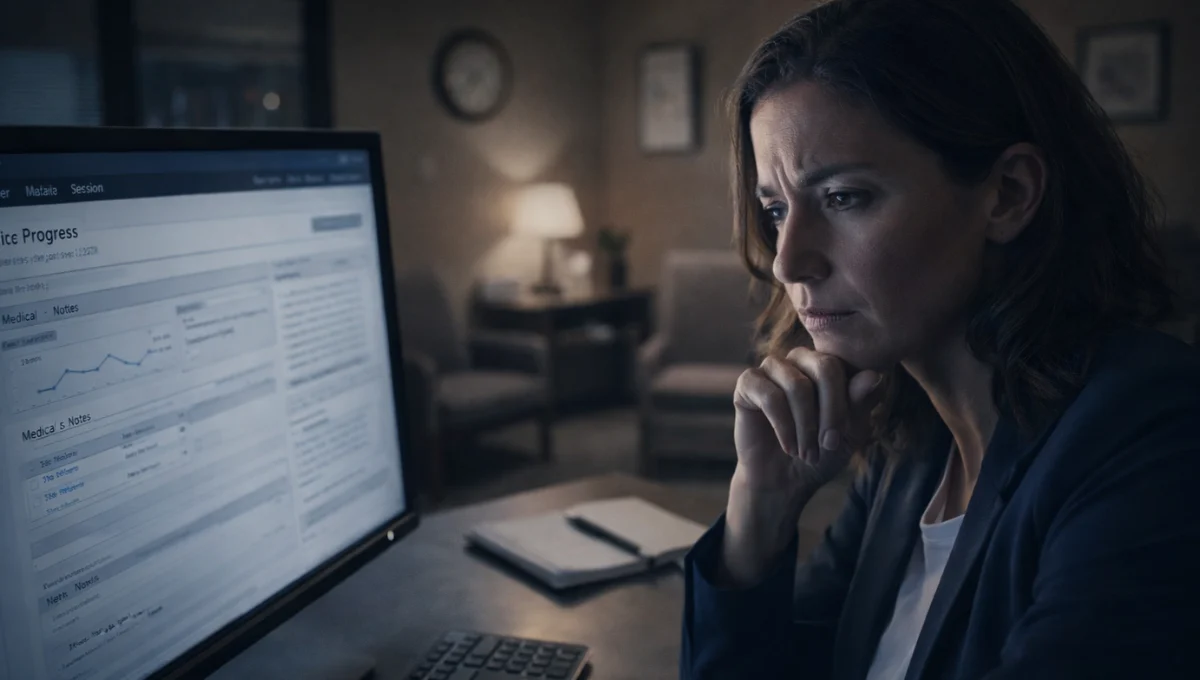

Retrospective charting describes recording of a clinical encounter once it is completed and usually at the end of the day or sometimes even days after. This practice applies in all fields of healthcare however, in particular in mental care as visits there are longer, emotional, and need prolonged focus.
Symptom checklists are not the only steps in psychiatric and counseling sessions. Clinicians should monitor variations over time, assess the risk, clarify their choice of medication, and communicate the purpose of therapy and be wholly present with the patient. In the case of full schedules and compact visits, documentation is usually done evenings or on weekends.
That delay is not harmless. Clinical reasoning and subtlety are very important in mental health notes. Documenting using the memory approach as opposed to documentation through live observation takes away details, makes details soft or even reconstitutes information out of bias. In retrospective charting, it is not just inconvenient any more. It places clinical, legal and ethical risk and undermines the history upon which future providers, auditors and patients base their efforts.
Table of Contents
How Retrospective Charting Affects Clinical Accuracy
The mental health care clinical accuracy relies on the real-time capture of observations and decisions. In the case where documentation is done retrospectively, clinicians have to depend on memory to recreate the encounter. Recall is prone to interference by subsequent impressions and memory fades following emotionally demanding sessions, and can consequently reshape the clinical record.
Retrospective charting usually has a number of impacts on accuracy:
- Symptom severity: It can be described in general terms, disregarding the details concerning the intensity, length, or evolution since the last visit.
- Rationalization of medication: Clinical reasoning of starting, stopping or postponing of medication can be made simple or even not taken.
- Risk assessment: Safety Concerns can be marked as complete not properly indicating the way the risk was assessed during the visit.
- Purpose in therapy: The purpose of the session or of the techniques applied may turn out to be vague or template-based, as opposed to encounter-specific.
This imprecision is more critical than in when dealing with psychiatry compared to most other specialties. Mental health care is not objective-tested and is a matter of longitudinal reasoning and judgment. This reasoning cannot be true when it is not documented at the time of care, as it makes this record less accurate and useful in future clinical decisions, audits, and continuity of care.
Documentation Timing and Legal Exposure
When working with mental health, the note can be important as it appears to be. The auditors, insurers, and reviewers of the legal critically examine the issue of whether documentation is done to show the real-time clinical decision-making. Even in cases where a visit was appropriate, the notes done some time after the visit are prone to an additional investigation.
Late entries are unlike contemporaneous notes in that they are based on reasoning that is rebuilt. The impact of this in psychiatry includes the understanding of the change of symptoms, assessment of safety, and medication choices. In cases where the record fails to provide reasoned decisions that were taken during the visit, the reviewers might doubt the medical necessity of such decisions as their decisions.
Retrospective charting also creates more chances of discrepancies between visits. Minor changes in the description of symptoms or treatment options may be ambiguous as time elapses.
In such cases, record protection is not guaranteed by clinical care. The guard to save clinicians is documentation that effectively justifies the decision-making at the moment.
Ethical Implications in Mental Health Records
Ethics in documenting the mental health is focused on truthful representation. Clinical notes should demonstrate what the clinician observed, evaluating what they saw and deciding what they saw, not bending under pressure and reflection, but reflecting the judgment at the moment of encounter.
Retrospective charting poses an obstacle to that duty. In later writing of the notes, clinical information might be recast unconsciously to fit conclusions instead of noting the way decisions were made. This implicates some ethical issues as to whether the record reflected the clinical experience as it happened.
Mental health records are sensitive also. They frequently involve intimate disclosures, risk factors and treatment decision making that should be well and specifically documented. In cases when such elements are summarised at a later time, the record may lose vital meaning though facts are not being deliberately distorted.
Because of these reasons, psychiatry documentation must be referred to as clinical care itself. Ethical practice is facilitated by taking notes in a timely manner and ensuring that they conserve accuracy, respecting the experience of the patient and ensuring that the medical record is not compromised.
Impact on Burnout and Clinical Sustainability
Retrospective charting has the propensity of moving the documentation into individual time. This typically translates to evenings or weekends spent struggling to rebuild emotionally demanding sessions following a clinical day that has ended.
The mentioned trend is contributing to burnout in a few ways:
- Cognitive fatigue: The willingness to remember sophisticated clinical thinking following numerous sessions augments mental work and decision fatigue.
- Emotional burnout: The returning of hard patient content not covered during the visit extends the emotional burden instead of the closure.
- Burnout cycles: Fall out of notes produces stress, which makes it more difficult to document and handle the notes accurately, which supports delay.
- After-hours charting (“pajama time): Notes written at late hours or during off days further shorten the time dedicated to rest and lead to the extension of the boundary between work and personal life.
Such cycles have a long-term impact on clinical sustainability. Differences between groups may involve the reduction of hours by providers, dissolving of a group, or even withdrawal of a group out of clinical work.
Not only individuals but also long-term stability of the workforce in mental health care is influenced by retrospective charting.
Practical Ways to Reduce Reliance on Retrospective Notes
Reducing retrospective charting in mental health care requires changes to the design of visits and documentation workflows. The goal is not to work faster, but to ensure that clinical reasoning is captured while it remains clear and accurate.
This may be facilitated through a number of system-level strategies:
- The recording visits aimed at assisting in-the-moment documentation: Mini pauses during or within minutes of the encounter would enable major observations, decision-making, and risk contemplation to be documented prior to proceeding.
- Do not use memory recall: To maintain clinical thinking, it is best to complete the notes on the visit or shortly after the visit to decrease the use of memory recall in several sessions.
- Mental health-specific noted templates: Psychiatry and counseling should have formats that can be used in the evaluation and administration of medication and focus as well as the treatment, and not a template that can be used and then backfilled.
- Enhance post-visit processes: Consistent actions following every visit e.g., brief summaries or well-formed questions, assist in making notes complete without haste or attempting to squeeze vital information inside.
Some practices support these workflows by using psychiatry-specific documentation systems, such as PMHScribe, which are designed to capture psychiatric reasoning, medication decisions, and therapy context during or immediately after the encounter rather than days later.
These approaches focus on system design rather than individual performance. When workflows reflect how mental health care is delivered in practice, documentation becomes more timely, accurate, and sustainable.
Conclusion: Protecting Care Quality Starts With Documentation Timing
Retrospective charting is not a workflow behavior only. It has an influence on the way clinical decisions are comprehended, examined, and proceeded in mental health care. Otherwise, when the time of documentation does not match with the encounter, this increases the obscurity in the records, and returns the onus upon clinicians.
Ensuring quality of care requires that the documentation is to be regarded as a component of the clinical moment, not an afterthought. Timely, accurate documentation systems contribute towards the maintenance of clinical judgment, lessening of the burden on the provider over time, and designing a more sustainable method of providing mental health care.
You must be logged in to post a comment.