
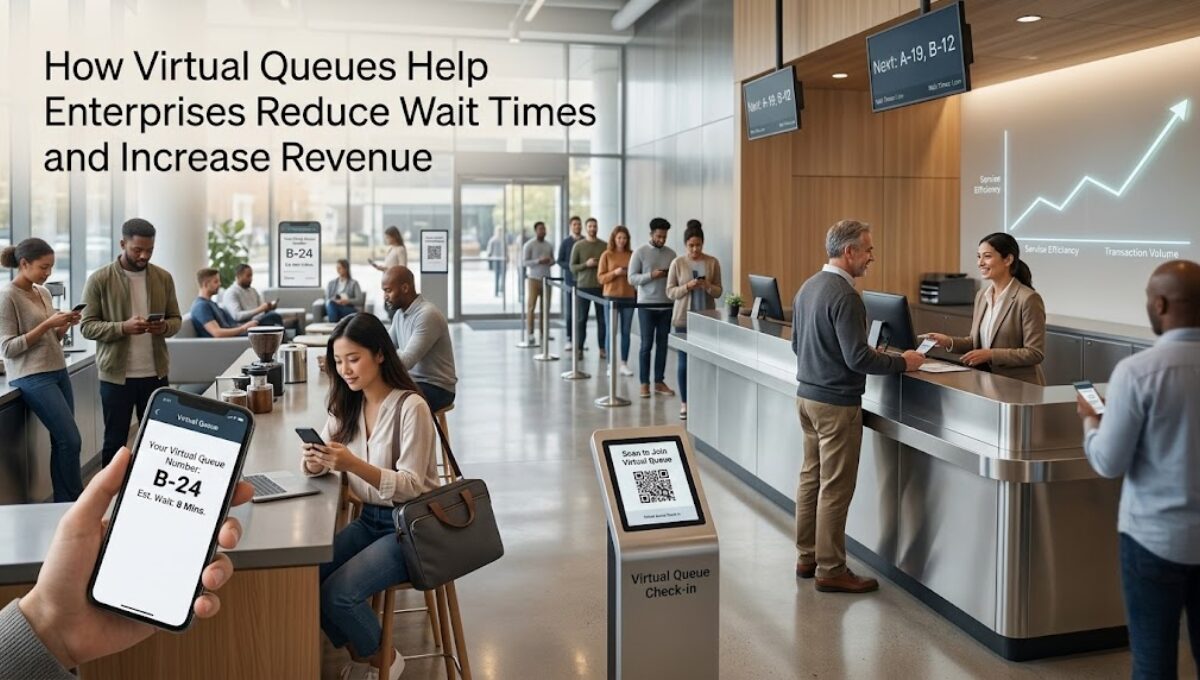

Every minute a customer spends standing in a long line is another minute they spend wondering if your business or service is even worth the trouble. Long lines aren’t just annoying for your staff; they actually hurt your revenue opportunities by making people lose trust in your brand. In today’s world, it is so easy for a customer to just pull out their phone and choose your competitor’s service over yours.
Major businesses have realized that they need to change how they handle their queues. It isn’t just about managing a line of people anymore. Instead, it’s about making the entire experience smooth from start to finish. Using “virtual queuing systems lets businesses allow their visitors to join a queue using their phones and wait remotely from anywhere until their turn comes up. This has been a major success for businesses, as it keeps the waiting areas calm and organised, and your staff members already know who’s next, so they can customise their services accordingly for a better customer experience.
Let’s discover how virtual queuing systems are being a success for businesses worldwide, and how they can help your business reduce visitor congestion for a better customer experience and ongoing revenue opportunities.

Table of Contents
The Hidden Cost of Waiting in Enterprise Environments
Most enterprises track service metrics. Very few track the cost of what doesn’t happen, i.e, the customer who walked away, the visit that never converted, the loyalty that quietly eroded. And the real hurt is there.
Stats even revealed that:
77% of customers won’t return after a bad waiting experience.
32% of visitors abandon a service visit when wait times are unclear.
Users tend to overestimate passive waiting (standing still) by 36%.
Here’s how it impacts your business:
Lost Revenue From Walkaways
Customers who leave without being served represent direct, unrecovered revenue loss. In high-volume industries, even a 5% walkaway rate can lead to a loss of millions annually.
Walkaways rarely complain; they simply don’t come back, making them invisible in standard reporting.
Brand Damage at Scale
In high-volume environments, a poor wait experience gets shared, reviewed, and remembered. This can lead to negative brand perception, and customers associate your brand with frustration over convenience.
What Is a Virtual Queue — From an Enterprise Lens?
Virtual queuing allows individuals to join a queue through their phone or a kiosk. Customers receive real-time information on the wait time, thereby avoiding the need to be in a crowd. For big companies, this is more than just a tool; it’s a smarter way to run a business. Here’s why it’s a must for every business to offer digital queuing for growth and customer convenience:
Demand Management Layer
It doesn’t just move people through a line; it actively shapes when and how demand arrives, making load distribution a controllable variable rather than a daily emergency.
Customer Flow Orchestration Engine
From first contact to service completion, the system coordinates touchpoints, channels, and timing, turning a chaotic walk-in environment into a structured, predictable journey.
Data-Driven Decision System
Every interaction generates data like major drop-off points, peak patterns, and service durations, giving operations teams the visibility to make smarter decisions in real time and over time.
“It’s not a queue system. It’s an infrastructure layer for how your business handles human demand.”
How Virtual Queues Actually Reduce Wait Times
Knowing how virtual queuing cuts wait times is essential for businesses that want to use it effectively. This understanding sets them apart from companies that only treat it as a superficial solution.
Demand Distribution
Virtual queuing eliminates the chaos of unannounced peak hours by spreading arrivals across time slots and locations.
Load balancing becomes an active management tool, not a reactive scramble when the lobby is already full.
Real-Time Queue Visibility
Queue analytics can let staff members plan their days. These reports are predictive and use factors such as weather conditions and past walk-in behavior to estimate how many customers may walk into your business.
This allows for effective resource allocation and makes sure nobody is overworked or idle, and customers get instant help as they come.
Pre-Service Engagement
Customers complete forms, check-ins, and pre-screening steps before they arrive, saving their time.
Shorter service time per customer means the queue moves faster for everyone, without adding a single staff member.
Smart Prioritization
VIP customers, urgent cases, and pre-scheduled appointments are handled with precision without disrupting the general flow or creating visible inequity at the counter
The outcome: Both actual and perceived wait times drop, and the difference between the two matters just as much for satisfaction scores.
How Reduced Wait Times Translate Into Revenue Growth
Speed is now more than just a measure of efficiency. In today’s market, focused on customer experience, it directly affects revenue. The calculations are easier than many businesses think. Here’s how the best virtual queue systems help businesses grow
Higher Conversion Rates
Fewer walkaways mean more completed transactions. Customers who feel their time is respected are significantly more likely to follow through on the purpose of their visit.
Increased Customer Throughput
Serve more customers within the same timeframe, but without adding staff, can be efficient, and it directly contributes to profitability.
Improved Customer Lifetime Value
A smooth, frictionless experience creates the emotional conditions for repeat visits and loyalty, both of which have compounding revenue effects over time.
Upsell & Cross-Sell Opportunities
During the wait period, businesses have a great opportunity to engage with customers and promote their business with personalized offers, product content, and service recommendations delivered while customers are already in the mindset to buy.
The Competitive Advantage of Eliminating Wait Times
The relationship between wait times and revenue is no longer a hypothetical idea; it is quantifiable, and in the case of large businesses, it does matter. Removing friction within the customer experience will not only raise satisfaction ratings, but also customer volume, and brand image that leads to loyalty over time.
Enterprises that invest in intelligent customer flow management aren’t just solving an operational problem. They’re building a structural advantage — one that compounds over time as competitors continue to lose customers to the clock.
The tools exist. The data is clear. The only variable left is urgency.
“If your customers are still waiting in line, your competitors are already serving them.”
You must be logged in to post a comment.