
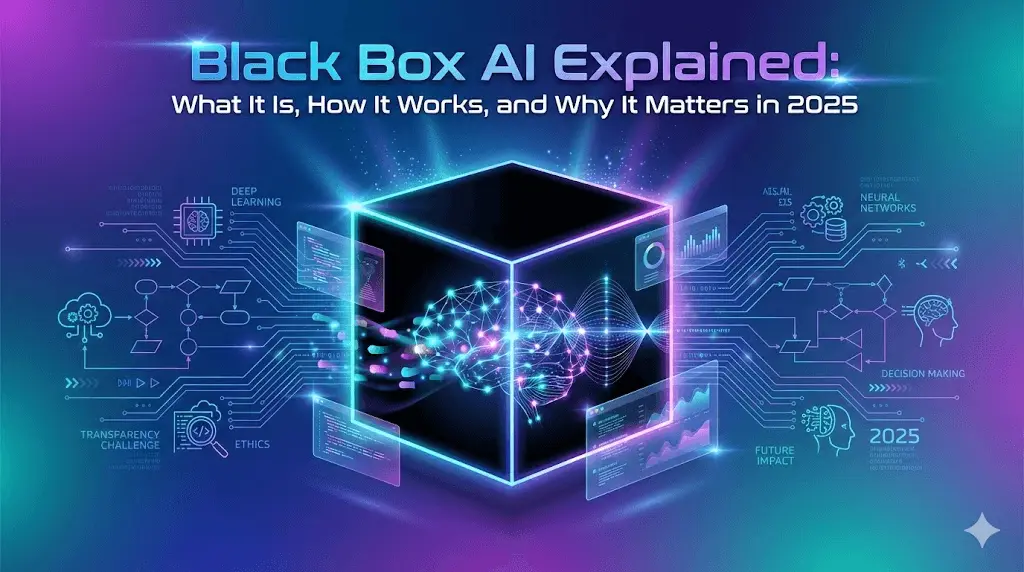

By 2025, black box AI nowadays is a hot topic with artificial intelligence driving a diagnosis of healthcare to financial trading. Think of putting data into a machine that gives you the correct predictions, but you do not know how it did it. That is black box AI in a word. Such models provide astonishing outcomes without showing their internal processes, which raises the questions of reliability, morality, and regulation. Though businesses are fond of the performance, experts are concerned with accountability. The guide simplifies black box AI in a breakdown using the recent developments, so that you can know its strength, dangers, and the transparency pressure.
Table of Contents
What is Black Box AI?
Black box AI is a form of machine learning in which the users have no insight into how this decision is made internally. You provide information, such as the customer behavior or a medical scan, and receive results, such as recommendations or diagnosis, yet the process of how is a mystery. A source of this opaqueness is complicated algorithms that are inspired by human intuition yet which cannot be explained step-by-step, such as deep neural networks with millions of parameters. A black box focuses on accuracy, as opposed to interpretability, unlike white box models, whose logic is transparent as simple decision trees. The most popular ones are ChatGPT to generate texts or facial recognition to be used by tech giants.
How Does Black Box AI Work?
Fundamentally, the black box AI is based on huge datasets that are trained by layers of interconnected nodes, which are analogous to a neuron in a brain. As the model trains, the weights are modified through backpropagation so that the model is as accurate as possible, resulting in patterns that are too complex to follow by humans. As an example, in image recognition, the pixels are manipulated via concealed layers into an operationalization such as edges or lines, and an ultimate classification is reached. There is no one formula that describes the result, it is intelligent computing of volumes of data and computing capacity. This has been enhanced by the developments of 2025 such as transformers, which allow models to deal with language, vision and code on the same platform.
Key Features of Black Box AI
Black box systems are most effective with processing unstructured data at large in seconds processing large volumes of data related to videos or text. Learning is done by trial and error, and new patterns are adapted to without manual adjustments. The accuracy can be very high and it may be better than the traditional methods, particularly in noisy real world conditions. It can be deployed to any domain, whether that is autonomous vehicles that identify obstacles or the mathematics of stock that forecasts crashes. It comes with non-determinism however but it is with probabilistic components that the same input may produce a slightly different output.
Advantages of Black Box AI
The attraction is crude performance. Black box models are the best in computer vision, natural language processing, and predictive analytics benchmarks, leading to innovations, such as personalized medicine, where physicians have to use AI scans. Enterprises save time in development – they do not have to write all of the rules – market penetration is quicker. The cost-effectiveness works best when it is used in high volumes, such as Netflix recommendation increasing the retention by 75%. Their generalization to unseen data is high, which is why it will be applicable to changeable settings such as fraud detection and changing scams.
Difficulties and Disadvantages
Opacity breeds risks. Decisions cannot be audited by the users, thus, biases amplified due to poor training data- imagine that facial recognition has mistakes with various skin tones. The failure to debug occurs when the outputs are not correct, since it is virtually impossible to identify causes of failure in millions of parameters. The regulatory barriers are also massive in 2025, as EU AI Act requires explainability of high-risk applications such as hiring or lending. Brittle performance on the real world data is due to overfitting to the training data and adversarial attacks mislead models with small modifications that humans cannot see.
Real-Life Cases and Implementations
Black box AI does well in recommendation engines that drive Amazon recommendations or Spotify playlists, examining user history to be uncanny. IBM Watson detects scans as cancer risks, which doctors in healthcare do not believe to have logic. It is used by autonomous cars manufactured by Tesla to navigate, and sensor data is processed on the spot. Black Box is used in algorithmic trading by finance to make millions of deals in a day. It is useful even in creative areas. DALL-E uses the opaque diffusion process to produce art based on prompts.
Going beyond Black Box AI Challenges
The year 2025 is marked by an explosion in Explainable AI (XAI) methodologies to demystify black boxes. LIME estimates local decisions by perturbing inputs, whereas SHAP gives feature scores of importance. Transformers have attention mechanisms that emphasize influential tokens. Partial transparency Hybrid models combine neural nets with rule-based layers. Predictions are interactively visualized in such tools as the What-If tool of Google. These mediate performance and trust that are requisite to controlled sectors.
The Future of Black Box AI in 2025: Trends and Future Projections
Rules drive transparency, as essential AI is an obligatory subject of audit. Federated learning learns on devices without sharing raw data, alleviating privacy concerns. Quantum computing will be faster in black box training. Ethical systems require prejudiced audits prior to deployment. XAI libraries based on open-source spread, giving authority to the developers. The future will see dominance of hybrid systems that are equally powerful and accountable as AI becomes more deeply embedded in the society.
Is Black Box AI the Right AI?
Select black boxes when the requirements are non-critical and have high accuracy such as content moderation. Choose explicable options in finance, medicine or justice where the stakes require reasoning. Evaluate risks: in case failure would cost lives or reputations, give XAI a priority. Test, audit datasets and overlay protection. By 2025, hybridisation will become the norm in most enterprises, using black box power using XAI wrappers.
Facts About Black Box AI
- Originally formulated in the cybernetics of the 1990s, it is now a core of 90 percent of production ML models.
- Deep learning black boxes have an accuracy of 99+ controlled tasks.
- Explainability is listed as the number one barrier in AI executives (70 percent).
- The XAI market in the world is estimated to be worth 20B in 2028.
- Cases of bias have decreased by 40% after post-2023 audits.
Conclusion
Black box AI trains 2025 breakthroughs but requires caution amid the risks of opacities. Its unequaled performance revolutionizes industries, but unexplainability gaps kill trust. Go with strong yet responsible XAI hybrids in the future. Regardless of whether one is creating apps or policy, scale accuracy versus transparency. Keep up with the changes in the regulation so that AI is used in a way that is transparent to humanity.
You must be logged in to post a comment.