
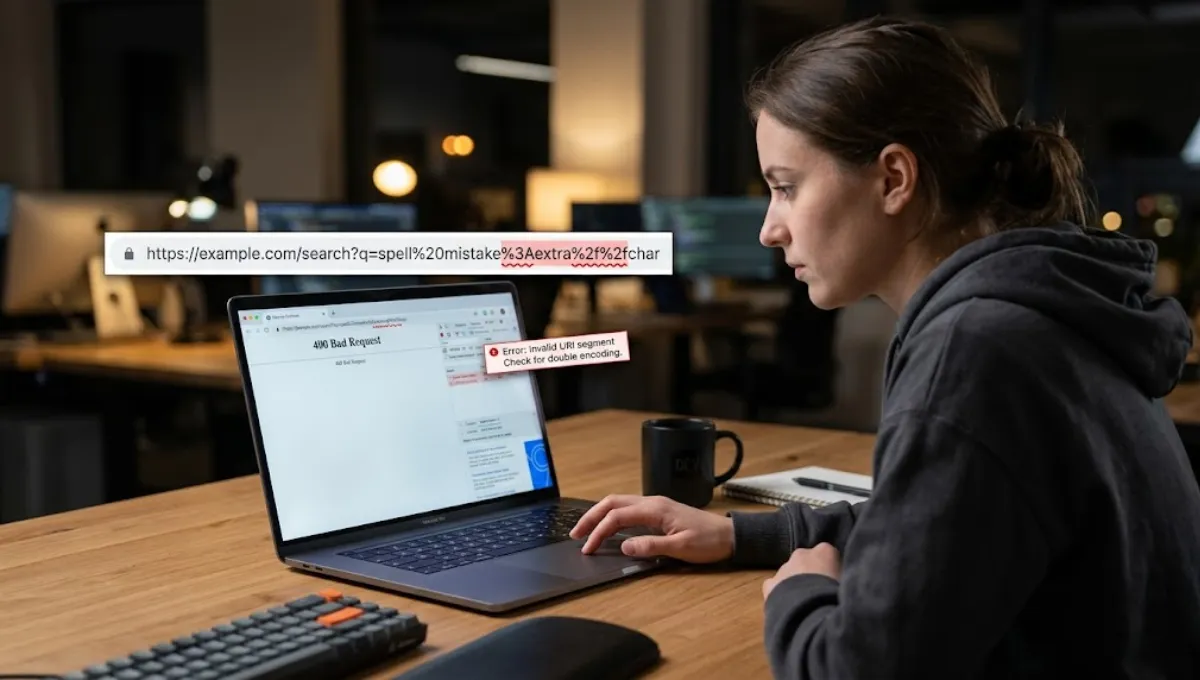

The abbreviation URL encoder spell error appears in several forums and web searches, it is common to see novice web developers bewildered and frustrated. Fundamentally, this term does not mean a particular error code or bug – it is typically a mix of basic typing mistakes and lack of understanding of the operation of URL encoding. A common search query by developers who encounter a broken URL, odd character in a browser URL, or unsuccessful API call is URL encoder spellmistake. Examples of the most frequent offenders are the spelling of encoder as encoder, mishandling of special characters such as spaces, ampersands or unintentionally encoding data twice. This tutorial divides the reasons, effects on search engine optimization and functionality, and viable solutions using examples in the developer blogs and troubleshooting websites.
Table of Contents
What Exactly Causes URL Encoder SpellMistakes?
The unsafe characters (spaces, the character of a question mark, the character of an and, the character of a pound, etc.) are substituted by the percent-coded counterparts (20, 3F, 26, 23) to make sure that browsers and servers can transmit data properly. A typo occurs when one types in spell encoder rather than spell encoder and gets 0 results as a result of typing the incorrect spelling. Along with typos, there are some actual problems due to incorrect encoding context. An example is the use of the entire URL in encoding as opposed to query parameters only leads to malformed links which disable navigation.
Table: Common URL Encoder Spelling and Usage Mistakes
| Mistake Type | Example Input | Resulting Problem | Use “URL encoder.” |
|---|---|---|---|
| Spelling Error | url encoder | No search results found | Use “URL encoder” |
| Space Handling | hello world → hello%20world | Correct, but often misunderstood | Always encode spaces |
| Double Encoding | Summer Sale” → Summer%2520Sale | Browser decodes twice, shows garbage | Encode once only |
| Full URL Encoding | encodeURI(https://example.com?a=1) | Breaks protocol/domain | Use encodeURIComponent for params |
| Ampersand Miss | a=1&b=2 → a=1&b=2 | Server parses wrong params | Encode & as %26 |
Why Do These Mistakes Break Websites and SEO?
Browsers can automatically fix URL encoder errors, but the server can ignore bad requests, leading to 404 error or lost analytics. In SEO, uneven encoding waters down the crawl budgets – Googlebot is sensitive to the use of the + and the use of the + in place of the 20, which might trigger a flag of duplicate content. Broken cart links cost e-commerce sites sales, mangled tracking pixels result in zero conversions on affiliate marketing sites. MrsDownloader notes that the most insidious killer is double encoding, on which a URL like Summer%2520Sale would become Summer%252520Sale, which cannot be easily seen by the human eye, but which kills any attempt to run it through a data parsing tool.
Table: Impact of URL Encoding Errors by Category
| Category | Consequence | Real-World Example |
|---|---|---|
| Functionality | 404 errors, failed forms | Login link with unencoded @ symbol |
| SEO | Duplicate pages, crawl waste | /page1%20 vs /page1+ variants |
| Analytics | Lost UTM data | source%3Dgoogle becomes source%253Dgoogle |
| Security | Open redirect bypass | Malicious //evil.com in poorly encoded paths |
| Performance | Extra redirects | Browser auto-fixes trigger server loops |
Real Technical Causes Behind the Confusion
Going further, there is a common disguise of parser mismatch as spellmistake. RFC 3986 is strict in defining URLs, whereas such browsers as Chrome are forgiving in the interest of usability. Example: example.com/path/ is considered valid according to most tools, but is invalid according to httptools. PHP Stack Overflow questions show that the rawurlencode() function of PHP confuses beginners, when it returns uppercase hex (%20 instead of the desirable lowercase preferred), which makes sense. InventiveHQ disapproves of the unnecessary bloating of URLs through encoding already-safe ASCII.
Special mention is to be made of double encoding. Original: “a b”. Single: a%20b. Double: a%2520b. Browsers deciphered the percentage 25 as a percent, which results in a%20b– works on the surface, but fails on the backend. According to HackerOne, this facilitates injection attacks whereby the user input does not pass validation.
Table: Encoding Functions Comparison
| Function | Use Case | Encodes | Safe For |
|---|---|---|---|
| encodeURI() | Full URLs | Minimal (unicode only) | Browser navigation |
| encodeURIComponent() | Params/Fragments | All reserved chars | Query strings, hashes |
| rawurlencode() (PHP) | Server-side | Full RFC compliance | APIs |
| decodeURI() | Reverse full | URI components | Display |
| decodeURIComponent() | Reverse params | Strict fragments | Data extraction |
Step-by-Step Fixes for URL Encoder Issues
Fixing starts with diagnosis. Copy suspect URL, paste into online decoder (urlencoder.org), compare input/output. For developers:
- Validate Spelling: Always “encoder,” never “encorder.”
- Choose Right Tool: Params? encodeURIComponent(). Full links? encodeURI().
- Test Iteratively: Generate → Browser → Developer Tools → Network.
- Avoid Double Encoding: Check if input already has % codes.
- Normalize Case: Prefer lowercase % codes for consistency.
Table: Quick Fix Checklist
| Symptom | Diagnostic Step | Solution |
|---|---|---|
| Strange chars in address bar | Inspect encoded string | Single-encode only |
| 400 Bad Request | Server logs | RFC-compliant encoding |
| Missing analytics | UTM decoder | Re-encode parameters |
| SEO duplicates | Screaming Frog crawl | Canonicalize variants |
| Mobile breakage | Device testing | encodeURIComponent all user input |
SEO and Marketing Implications
The URL encoder mistakes have the greatest negative impact on the marketers. UTM parameters such as utm_source=google%20ads are silent on an occasion of being double-encoded. GA4 decreases the sessions; Ad expenditures are wasted. Clean URLs increase the number of clicks – people place their trust in example.com/sale instead of example.com/sale%2520offer. The search engines favor the regular structure; the randomized encoding is an indication of poor sites.
Table: Before/After Encoding Examples
| Scenario | Broken URL | Fixed URL | Improvement |
|---|---|---|---|
| Product Link | /item?name=shirt & size | /item?name=shirt%26size | Parses correctly |
| UTM Tag | utm_term=summer sale | utm_term=summer%20sale | Analytics tracks |
| Share Link | Hello%20World%20! | Hello%20World%20! (decoded) | User-friendly |
Advanced Prevention for Developers
Include libraries: URLSearchParams built-in in JavaScript automatically encodes. Backend: urllib.parse.quote of Python. The URLs to be deployed by CI/CD pipes must be limited. Track on New Relic or Datadog 400 spikes to campaigns.
Table: Language-Specific Best Practices
| Language | Recommended Method | Pitfall to Avoid |
|---|---|---|
| JavaScript | new URLSearchParams() | Manual % replacement |
| PHP | http_build_query() | rawurlencode overuse |
| Python | urllib.parse.urlencode | str.replace hacks |
| Node.js | querystring.stringify | Double JSON parse |
Conclusion
The URL encoder spellmistake encoder takes a range in between the innocent typing errors and serious coding errors that crash websites and search engine optimization. Proper spelling will result in instruments, proper use will result in no downtime. Think once, test twice, normalize third. 90 percent of the headaches are solved by developers who understand the encodeURI vs encodeURIComponent. Marketers, religiousise UTMs. Clean URLs translate to happy users, data being tracked and even search rankings.
Frequently Asked Questions (FAQs)
Ans. Spellmistake Typically, the URL encoder spellmistake is the typing of encoder instead of encoding when search engines are used to find URL encoding tools, or a misunderstanding of encoding errors such as doubling percent-coding (as in %2520 or %20). It results in dead-ends or unsuccessful searches.
Ans. The typical reasons are misspelling of encoder, confusions between encodeURI and encodeUriComponent, or encoding data twice. Spaces are converted to 20 and 2520; ampersands (&) will disrupt parameters.
Ans. It brings about 404, lost analytics (UTM breaks), SEO duplication and security risks such as open redirects. Browsers can correct some of them, whereas servers do not accept malformed URLs.
Ans. Query param: encodeURIComponent() Full URL: encodeURI(). Test in browser dev tools. Avoid manual % replacements. Such tools as urlencoder.org are instantly validated.
Ans. Yes-messy encoding generates crawl garbage, confusions of parameters and duplicate pages. Google gives encoded variants different treatment causing a dilution of rankings and link equity.
You must be logged in to post a comment.